There are two important things to know about tracking wild elephants, and it's better to learn both of them before you're actually in the jungle, tracking wild elephants. First, elephants are fast. In thick forest – in this case, the vast Ulu Masen ecosystem in the Indonesian province of Aceh, where leeches writhe beneath your feet and white-handed gibbons hoot from the treetops – they can outpace even deer. Second, elephants can't climb trees. This is good, because that's precisely what you're meant to do if one of them charges.
Reporting for TIME on saving the world's rainforestsRead the full story
Among Manchester United Football Club's 300 million supporters worldwide are two Burmese men whose love of the game spans generations. One is a stout, bespectacled septuagenarian, the other his favorite teenage grandson, and like many of their soccer-mad compatriots they stay up late to watch live broadcasts from faraway England. So far, so normal. But knowing the grandfather in this touching scene is General Than Shwe, the xenophobic chief of Burma's junta, makes it seem all wrong. Rabidly anti-Western, yet pro-Wayne Rooney: is this the tyrant we know and hate?
Reporting for TIME on Burmese dictator Than ShweRead the full story
The fakes contained a variety of drugs and chemicals, some of them downright toxic. There was metamizole, which can cause bone marrow failure and is banned in the U.S.; the outmoded antimalarial drug chloroquine; acetaminophen, a pain-reliever that dulls such malaria symptoms as pounding headaches and can fool patients into thinking they're getting better; and safrole, a carcinogenic precursor to MDMA, better known as Ecstasy. Worse, some bogus pills contained small amounts of genuine artesunate, which could cause the malaria parasite to develop resistance to the drug – a public health disaster.
Reporting for the SMITHSONIAN MAGAZINE on fake antimalarial drugsRead the full story
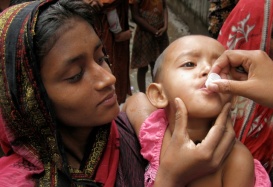
Dhaka is a seething, fractious, heart-bruising place. Its residents seem to spend their days close to boiling point, waiting for someone or something to rattle their lids off. For the outside world, it is also a climate change experiment writ huge. Dump millions of people into low-lying slums between filthy, flood-prone rivers; raise the sea levels; melt the glaciers; unleash cyclones, storm surges, and climate-sensitive diseases. Then double the population of those slums every decade.
Reporting for DISPATCHES on climate change in BangladeshRead the full story
I MEET an old man, a retired engineer, choked with emotion. Had he joined the protests? "No," he replies. "I am too old to run from bullets." More military trucks race past; one soldier trains his rifle on the crowds, and scowls. "Quick, we must go," says the old man. "They are going to start shooting us." I can still hear gunfire at 5pm – continuous, loud, high-caliber, some of it very close, most of it caroming through the streets from the east. I phone a Burmese friend in the area. He is holed up in his house with his wife and three children. "What's happening?" I ask. He replies: "They are hunting us."
Reporting for TIME magazine on Burma's 2007 democracy protestsRead the full story
COMRADE Giegie is getting married. Her wedding will be held in a jungle clearing, which she will enter through an archway of raised assault rifles. The bride and groom will make their vows draped in a red flag bearing the spear and Kalashnikov of the New People's Army. Then they will pledge allegiance to the masses and promise to raise their children as revolutionaries. There will be no priest, no confetti, no wedding gown. So how will Giegie dress? "Like this," she smiles. Giegie, 22, is wearing a faded sweatshirt, jogging pants, Wellington boots and an Ingram submachine gun.
Reporting for THE SUNDAY TIMES MAGAZINE on Communist rebels in the PhilippinesRead the full story
HAMENGKU Buwono X – the name means "he who carries the universe on his lap" – heads a dynasty that dates back to the 18th century. The sultan's official portrait shows him in full Javanese court attire, a curved dagger tucked into his magnificent batik sarong. His everyday wear is an impeccably tailored dark suit-preferably Armani. In his office, during an interview, he puffs on a fat Davidoff cigar. A large painting of a volcano hangs on the wall behind him. "Not Merapi," he says dismissively. "Fuji."
Reporting for NATIONAL GEOGRAPHIC magazine on the volcanoes of IndonesiaRead the full story
WHILE my colleague Philip Blenkinsop photographed the scene, and I talked to police and emergency workers, neither of us suspected that a bomb lay buried beneath the road, and it was about to go off. Up close, you don't hear explosions. You feel them. There was a flash, and then what felt like an invisible baseball bat, swung with full force, struck me around the head. For a few moments, everything went utterly silent, but as I stumbled from the scene some of my hearing returned. I thought I heard rain. It was the sound of hundreds of bits of blood-smeared road returning to earth.
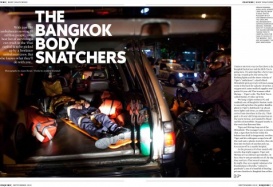
Reporting for THE SYDNEY MORNING HERALD on the Muslim insurgency in ThailandSOMCHAI is a detective in northeastern Thailand. One of his relatives was killed during the drug war, and he is convinced the culprit is a policeman. "I think he's one of my own men," he says. Somchai blames only a few murders on "bad guys killing bad guys." Most were carried out by teams from provincial or regional police commands. These death-squads identified their targets with help from local police, who provided mugshots and then made themselves scarce. Sometimes, says Somchai, cops were called to the station for a non-existent meeting, while the killers got to work.
Reporting for THE SUNDAY TIMES MAGAZINE on Thailand's war on drugsRead the full story
NOBODY comes from Pattaya but everyone seems to go there. At weekends, the foreign crowds are swelled by Thai day-trippers from landlocked northeast who have never seen the sea before. They bathe in it fully clothed, in the demure Southeast Asian style, or take sneaky photographs of Eurotrash in microscopic swimsuits. There used to be a Thai saying: "If you want to see a naked foreigner, go to Pattaya." And naked Thais, of course. By night, the city is ablaze with go-go bars overflowing with Thai women beckoning to potbellied Westerners in Camel Active wear.
Reporting for TIME magazine on the notorious Thai resort of PattayaRead the full story
JAFFAR glances at his gold wristwatch and makes apologies. It is almost time for prayers at the compound's mosque. "I don't want to get carried away with this issue of anti-Americanism," he says, almost as an afterthought. He thinks for a moment. "Because some Americans are Muslims, too." Then he stands up and stretches, and for the first time the logo on his undershirt is clearly visible. It is not, as I had initially thought, the clashing sabers of Laskar Jihad. It is a Playboy bunny.
Reporting for THE NEW YORK TIMES MAGAZINE on Islamic fundamentalists in IndonesiaRead the full story
"MY daddy gave me my first gun when I was four years old," says Ralph Passonno. Now the owner of a Colt AR15 semi-automatic, Passonno is a plump, jovial man with a white beard. He's like Santa Claus, but better armed. Passonno hates federal agents, but he loathes the French. "We've done a lot for them," he says. "They've done nothing for us. They hate us." But Passonno likes Germans, because he believes they only opposed the Iraq war due to brainwashing by a socialist government and a liberal media. Also, Germans make nice guns. "High-precision, very reliable, top quality," he says. Also, his wife is Bavarian.
Reporting for THE HERALD MAGAZINE on the world's largest machine-gun festivalRead the full story
KHAIRURRAZI Ismail was always going to die young. He said so himself. When his father passed away, the 18-year-old had wrapped the old man's body in a cotton shroud, then taken the remaining material to his mother. "Keep this safe for me," he told her. "I'll need it soon." Khairurrazi, always a thin, sickly youth, had expected an illness to kill him. Instead, he was beaten and bayoneted, then shot in the head. "Half his skull was blown off," wept his mother, Ramla, clutching a Muslim prayer book. "I had to pick up my poor boy's brains and put them back in his head."
Reporting for TIME on Indonesian army atrocities in Aceh provinceRead the full story
THE platforms at Amritsar were clogged with huge hessian mailbags secured with Dickensian wax seals. Behind one barricade of luggage sat R.P. Singh, a constable with the Border Security Force. He was going home after a year in Kashmir, which he called "a very fine and peaceful place," not withstanding the fact that India and Pakistan had fought two wars over it. Was another likely? "No chance! But believe me," R.P. Singh added gravely, "we are ready to fight. We will fight Pakistan with our guns, with our bare hands, with our . . ." He had run out of things to fight the Pakistanis with. "Cup of tea?" he inquired.
Reporting for TIME on India-Pakistan nuclear brinksmanshipRead the full story
I HAD first visited Mandalay via train from Rangoon, a trip so long that giant spiders had spun terrifying webs from the luggage racks by our arrival. This time I went by air, which meant landing at an eerie monument to Burma's economic mismanagement. Topped with baroque spires to recall the splendors of Burma's royal past, Mandalay International Airport was completed at a cost of $150 million. Today, ox-carts ply its grand, four-lane approach road while the building slumbers in near darkness. Passengers check in for a handful of daily flights, then clump down a dormant escalator to a stifling departure lounge, where they fan themselves with their boarding cards.
Reporting for TIME on Burma's enduring military dictatorshipRead the full story
AN Arkansas-based missionary outfit called The Traveling Team recruits on U.S. campuses with slick videos and internet testimonials. The catchphrase of youth group Real Impact Missions – "Go. It's that simple" – echoes not only Jesus's exhortation in Matthew 28 ("Go ye therefore, and make disciples . . .") but also the jacket advice on Lonely Planet guidebooks: "Don't worry about whether your trip will work out. Just go!" A group called Youth With A Mission runs short-term mission trips for children as young as eight.
Reporting for THE TELEGRAPH MAGAZINE on a surge in U.S. missionary activityBY 6 a.m., morning practice is in full swing at the Wakamatsu stable in Tokyo. Two wrestlers are locked in a brutal embrace in the dirt ring. Watching them are about 20 others, ranging from pudgy, girlish teenagers to big-bellied giants with sagging breasts. Rising from the ranks is a chorus of slapping fat and smoker's coughs, along with the occasional, titanic fart. In the air, the fragrance of the wrestlers' perfumed top-knots fights a losing battle with the king-size reek of men sweating in Niagaran volumes. Morning practise is sumo in the raw. Watch it, and you will never again dismiss the sport as fat boys grappling in nappies.
Reporting for ESQUIRE on a match-rigging in Japanese sumo


|